Overlay material is a decision made once and lived with for the life of the product. It controls how the keypad looks, how it ages, which chemicals it can survive and what the keys feel like. Yet it is often specified from a short habit: "polyester" or "polycarbonate" with little thought for the rest of the list.
This guide covers every material you are likely to meet and where each one fits. For a deep head-to-head of the two most common, see our guide to polycarbonate vs polyester overlays.
Why This Matters
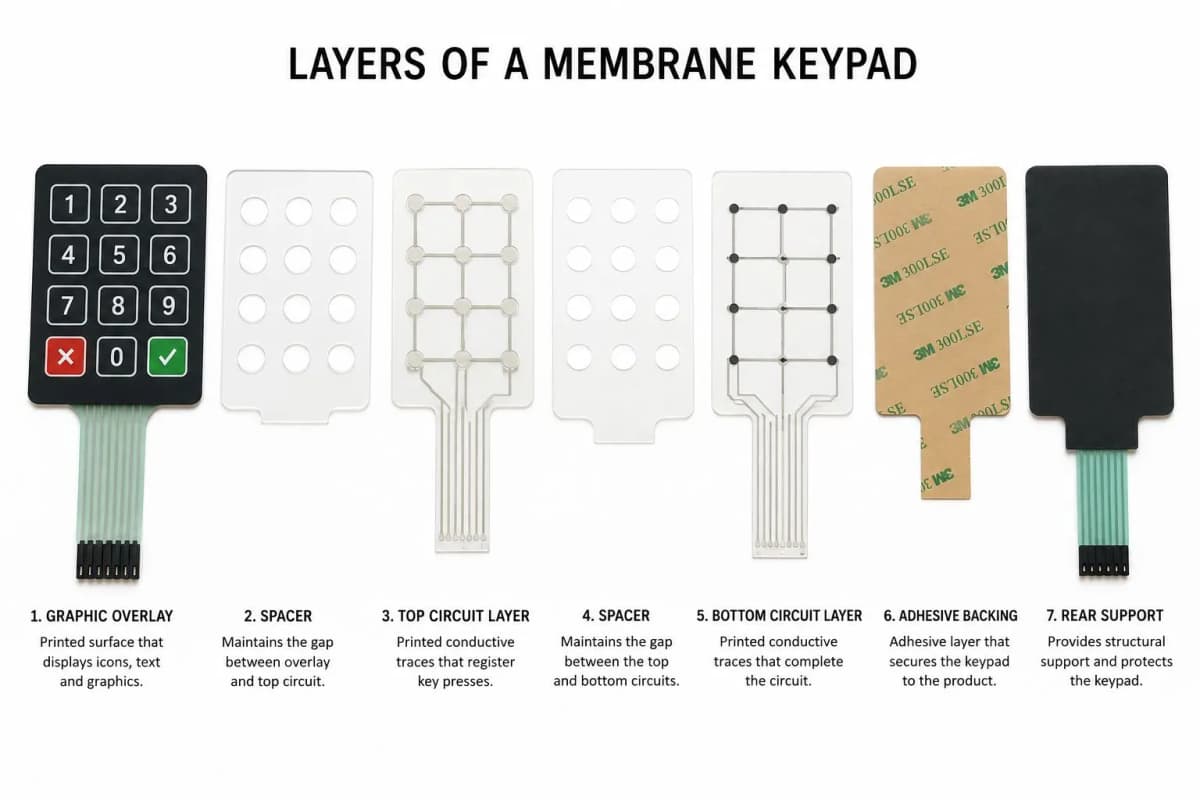
The overlay is both a cosmetic and a structural layer. It carries the graphics, forms the embossed keys, forms the barrier to the environment and transmits light in backlit designs. Different materials do these jobs differently, and the weakest property usually decides the product's life.
Material choice also links to other decisions: adhesive compatibility, printing ink, hardcoat options, backlighting and the thickness of the whole stack.
Key Takeaways
- Polyester (PET) and polycarbonate (PC) cover most membrane switch overlays; the others serve special roles.
- Polyester favours chemical resistance, UV stability and flex life. Polycarbonate favours clarity, deep embossing and impact strength.
- Polyimide is for circuits that must survive soldering heat, not for visible overlays.
- Rigid acrylic, glass and metal are used as front panels over or around a membrane switch.
- Choose the material from the environment and the tactile design, and validate it with the adhesive and hardcoat.
Polyester (PET)
Polyester is the workhorse. It is a semi-crystalline polymer with excellent dimensional stability and chemical resistance.
Strengths: strong resistance to many solvents and cleaners, good UV stability, high flex life at embossed keys, stable under printing and curing, cost-effective.
Limitations: less deeply embossable than polycarbonate, lower impact toughness and slightly lower optical clarity in some grades.
Typical use: industrial, outdoor and high-use keypads, and as the base film for printed-ink circuits.
Polycarbonate (PC)
Polycarbonate is a tough, clear, amorphous thermoplastic that forms well.
Strengths: excellent clarity, deep and crisp embossing, high impact resistance, good for backlit and display windows.
Limitations: more sensitive to some solvents and to UV unless protected, and generally lower flex life at embossed sites.
Typical use: indoor equipment, deeply embossed keys, clear display windows and backlit panels.
PETG and Other Copolyesters
PETG is a glycol-modified polyester that forms more easily than standard PET.
Strengths: good clarity, easy to thermoform and die-cut, decent chemical resistance.
Limitations: lower heat resistance and scratch resistance than PET with hardcoat.
Typical use: formed covers, labels and lenses where ease of forming matters.
Acrylic (PMMA)
Acrylic is a rigid, optically clear sheet used for fascias, lenses and panels.
Strengths: very clear, polishes well, takes edge finishing and engraving, available in many colors.
Limitations: brittle compared with polycarbonate, and not suited to flexing.
Typical use: front panels and display windows that sit with a membrane switch behind them. See our custom acrylic panels.
Polyimide
Polyimide is the amber film used as the base of flexible printed circuits.
Strengths: very high temperature resistance, stable, supports copper etching and soldering.
Limitations: higher cost, and not used as a visible overlay.
Typical use: FPC circuits and tails. Our guide to circuit types explains when to choose it.
PVC and Vinyl
PVC film is inexpensive and easy to print and cut, but it has weaker chemical and temperature behaviour and ages poorly in many industrial settings.
Strengths: low cost, easy to work.
Limitations: not recommended for membrane keypad key surfaces in demanding environments.
Typical use: non-critical labels and decals; see our vinyl graphics.
Metal and Glass Fronts
Anodized aluminum, stainless steel, brass and glass are used where a premium or rugged front is needed. Capacitive touch and thin membrane switches can sit behind them or be integrated with them.
Strengths: premium look, extreme durability, resistance to abrasion and chemicals.
Limitations: cost, weight and the need for a different interface technology in many cases.
Typical use: premium appliances, rugged controls and vandal-resistant panels. See our anodized aluminium labels and capacitive touch panels.
Overlay Materials Compared
| Material | Clarity | Chemical resistance | UV stability | Embossing | Flex life | Relative cost |
|---|---|---|---|---|---|---|
| Polyester (PET) | Good | Excellent | Good | Moderate | Excellent | Low |
| Polycarbonate (PC) | Excellent | Fair | Fair, needs protection | Excellent | Good | Moderate |
| PETG | Very good | Good | Fair | Good | Fair | Low to moderate |
| Acrylic (PMMA) | Excellent | Fair | Good | Not applicable | Poor | Moderate |
| Polyimide | Amber | Excellent | Good | Not applicable | Excellent | Higher |
| PVC | Good | Fair | Fair | Limited | Fair | Lowest |
| Metal or glass | Opaque or clear | Excellent | Excellent | Not applicable | Not applicable | Highest |
Gauge and Stiffness
Thickness changes feel as much as material does. A thicker overlay is stiffer, which damps domes and reduces the emboss cue. A thinner overlay is more fragile and can show telegraphing of components beneath. Choose gauge together with the dome and emboss, as described in our dome types guide.
Manufacturing Insight: When the environment is harsh and the budget is tight, polyester with a suitable hardcoat is usually the safest first prototype. Move to polycarbonate only where clarity, embossing depth or impact strength clearly justifies it.
Hybrid Constructions
A common solution combines materials: a polycarbonate window for clarity over a display, with a polyester field for the surrounding graphic. Rigid acrylic or metal can frame the membrane switch behind it. Hybrids capture the strengths of each material but need careful bonding and edge sealing.
Typical Applications
- Polyester: industrial controls, outdoor keypads, fuel dispensers and cleaning-heavy products.
- Polycarbonate: medical and indoor equipment, backlit panels and deeply embossed keys.
- Acrylic: decorative panels and display lenses.
- Metal and glass: premium and rugged fronts.
Common Mistakes
- Choosing PC outdoors without protection. UV can yellow and crack it.
- Choosing PET for deep embossing. The dome will be shallower and can flatten.
- Ignoring gauge. Thickness changes feel and light transmission.
- Forgetting adhesive compatibility. Not every adhesive bonds equally to every film. See our adhesive types guide.
- Overlooking cleaning chemicals. Solvents attack some materials quickly.
- Using vinyl where life matters. PVC ages poorly in demanding use.
Decision Framework
- Will the keypad see outdoor UV or harsh chemicals? Start with polyester.
- Does it need deep embossing, high clarity or impact strength? Consider polycarbonate.
- Does it need to survive soldering heat? Use polyimide for the circuit.
- Is a premium, rigid front needed? Consider acrylic, metal or glass in front of the interface.
- Is the product backlit? Check clarity and ink opacity.
- Pair the material with a hardcoat, surface finish and adhesive that suit the environment.
Frequently Asked Questions
What materials are used for membrane switch overlays?
The most common are polyester and polycarbonate. Others include PETG, acrylic for rigid panels, polyimide for high-temperature circuits, and metal or glass for premium or rugged fronts.
Is polyester or polycarbonate better?
Neither wins everywhere. Polyester generally resists chemicals, UV and flex fatigue better, while polycarbonate offers better clarity, embossing depth and impact toughness.
What material should the circuit layers use?
Printed-ink circuits are almost always on polyester, while copper FPC circuits use polyimide.
What overlay thickness is typical?
Membrane keypad overlays are commonly a few thousandths to around ten thousandths of an inch, with thicker material for rigid panels. Thickness is chosen with the dome and emboss.
Can I use acrylic as a keypad overlay?
Rigid acrylic is used for panels, lenses and fascias, not as a flexible key surface. It is often combined with a membrane switch behind it.
Which overlay material is best outdoors?
Polyester with a UV-stable construction is usually the safer outdoor choice, while unprotected polycarbonate can yellow and crack.
Conclusion
Overlay material is a trade between clarity, chemical resistance, UV life, embossing and cost. Polyester and polycarbonate cover most needs, while polyimide, acrylic, metal and glass serve special roles. Pick from the environment first, then confirm the choice with the adhesive, hardcoat and tactile design.
For help choosing a material, talk to our engineering team.