
Specifying the wrong overlay substrate doesn't show up on day one. It shows up eighteen months into a field deployment, when the embossed keys on a fuel dispenser start flattening, or when a control panel that's spent two summers in direct sun starts yellowing at the seams. This guide walks through how polycarbonate and polyester actually differ at the material level, where each one wins, and how to make the call before it becomes a warranty problem.
This is written for the people who carry that decision: OEM design engineers speccing the part, product designers balancing look and feel against cost, purchasing managers comparing quotes that don't obviously explain why one material costs more, and manufacturing engineers who have to actually build the thing at volume without a yield problem.
Why This Matters
A graphic overlay is usually the cheapest component in an assembly and the first thing a user touches. That asymmetry is where most material-selection mistakes come from — teams treat the overlay as a graphics problem (what does it look like) when it's actually a materials engineering problem (what does it survive).
The failure modes are predictable once you've seen them a few times. A polycarbonate overlay specified for an outdoor traffic controller because "it's the strong one" yellows and craze-cracks at the embossed switch sites within two seasons of UV exposure, well before the electronics underneath fail. A polyester overlay specified for a medical device because "it's cheaper" turns out to take an embossed dome with less definition, and the tactile click that nursing staff rely on to confirm a button press without looking at it disappears after a few thousand cycles. Neither material is wrong in the abstract. Both were wrong for that environment.
The cost of getting this wrong is rarely the overlay itself — a sheet of film is inexpensive. It's the re-spec, the re-tool, the field retrofit, or the warranty claim on a product that's already shipped. Getting the material decision right at the design stage is the cheapest point in the entire program to fix it.
Key Takeaways
- Polyester (PET) is the default choice for outdoor exposure, frequent chemical contact, and high actuation-cycle applications — UV stability, chemical resistance, and flex fatigue life all favor it.
- Polycarbonate (PC) is the default choice for backlit displays, deeply embossed tactile keypads, and indoor equipment where optical clarity and impact resistance matter more than long-term UV exposure.
- Embossing depth and dome definition favor polycarbonate; embossing durability over thousands of cycles favors polyester.
- Raw material cost favors polyester, but the comparison has to be run per-part — polycarbonate's better embossing yield can offset its higher per-square-foot cost in some constructions.
- Hybrid constructions (a PC window over a PET field) are standard practice and often the right answer rather than a forced single-material choice.
What Graphic Overlays Actually Are
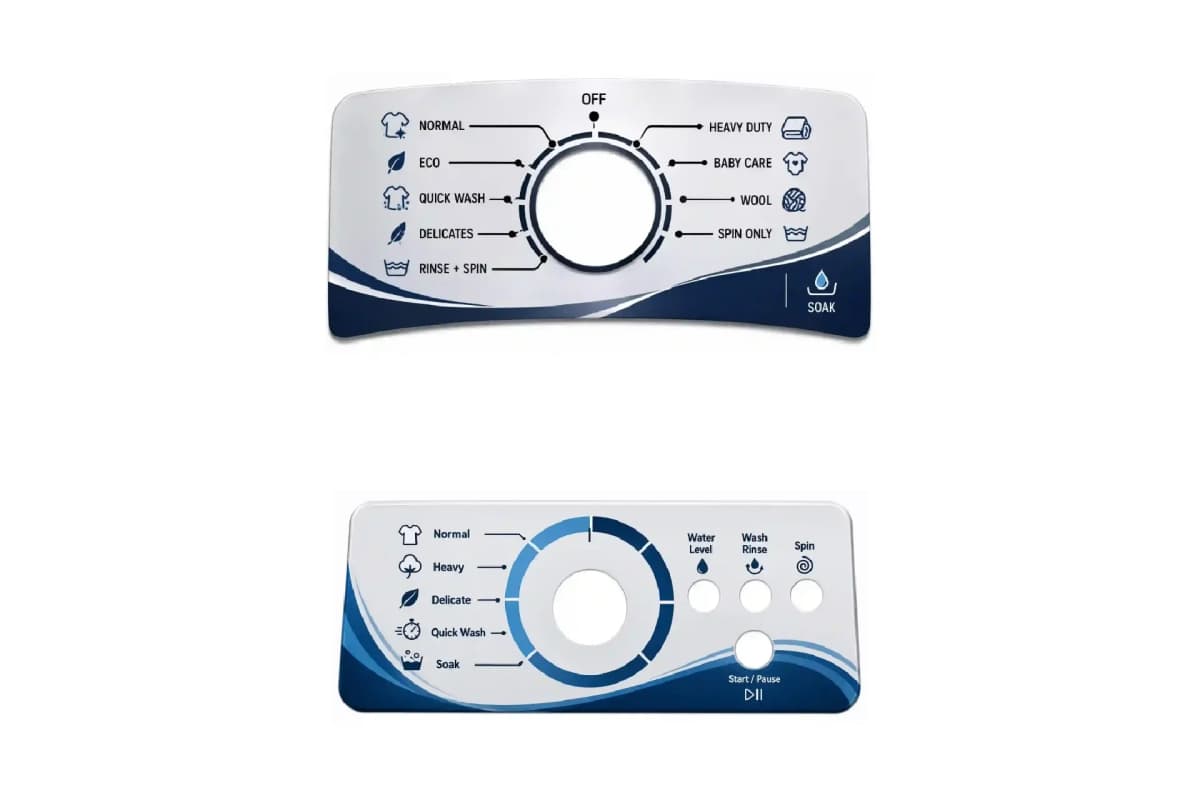
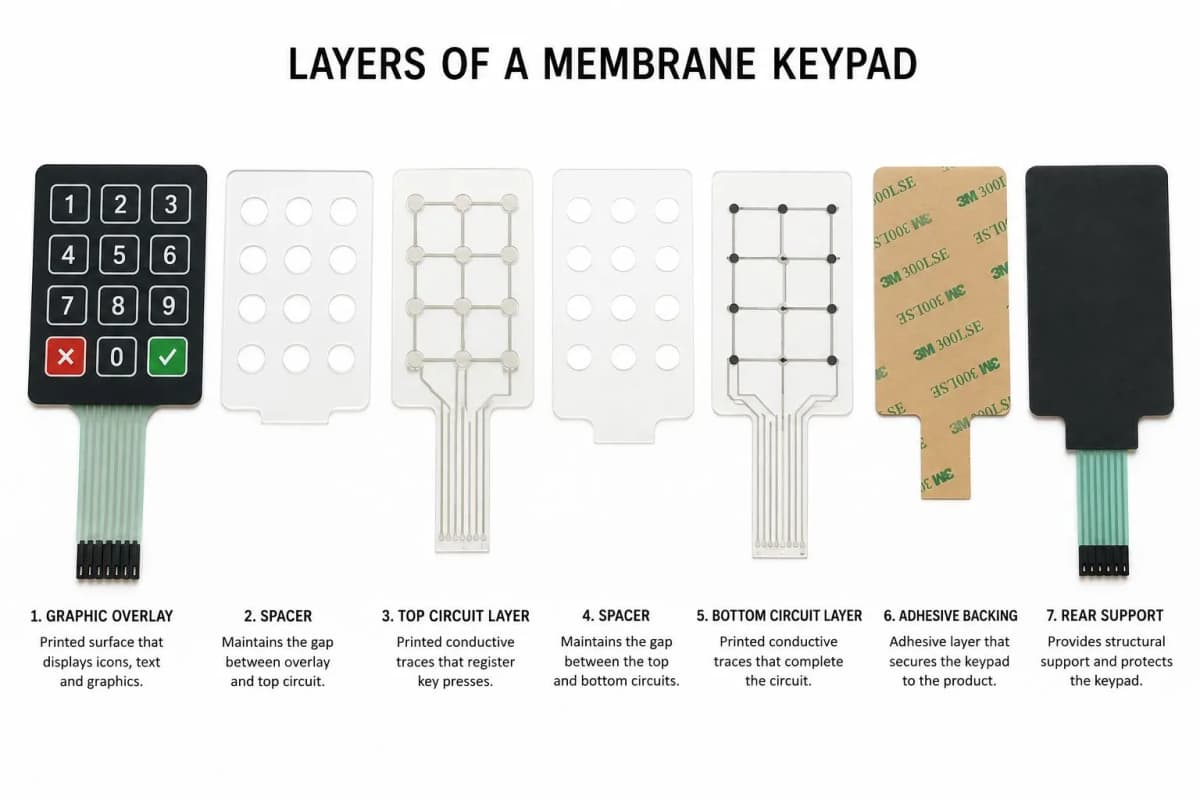
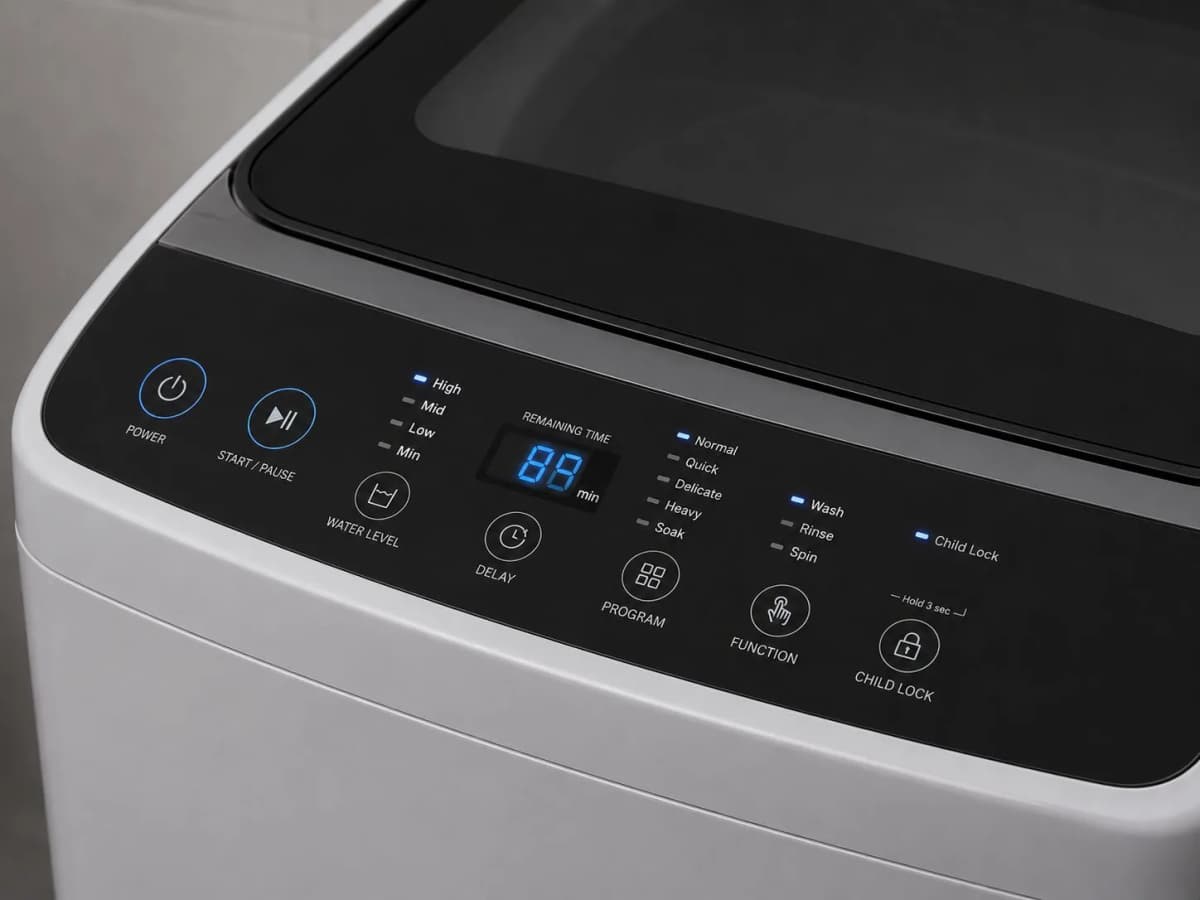
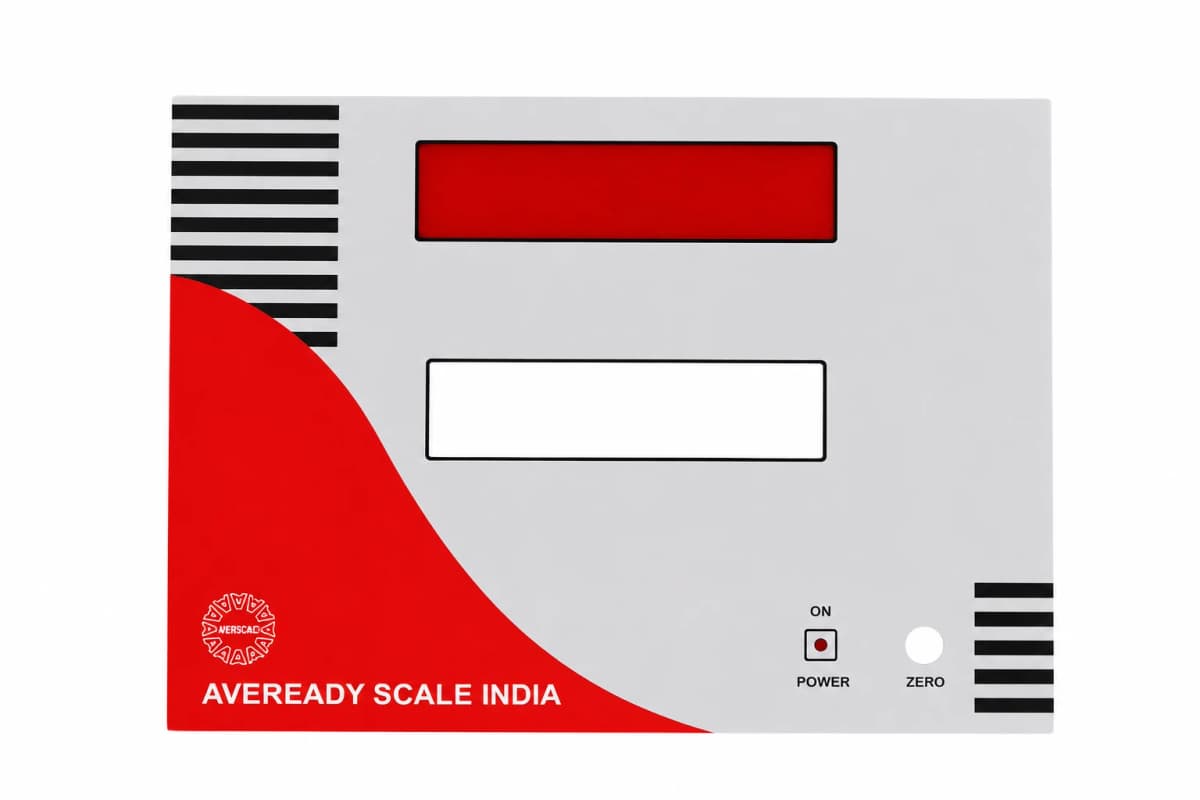
A graphic overlay is the printed, embossed front layer of a human-machine interface — the surface a user sees, touches, and presses. In a membrane keypad assembly it sits on top of a spacer adhesive layer, a dome or circuit layer, and a flexible printed circuit (FPC) tail that routes the signal out. In a standalone application it might be the entire interface: a printed and die-cut overlay laminated directly over a capacitive touch sensor or an LED display window.
The overlay does three jobs simultaneously, and material selection affects all three differently:
- Structural — it's embossed to create the tactile dome a finger presses, and it has to survive repeated flexing at that dome site without cracking or fatiguing.
- Optical — it's printed (usually second-surface, meaning ink sits on the back of a clear or translucent film so the film itself protects the ink) and often backlit, so clarity, haze, and light transmission all matter.
- Environmental — it's the only barrier between the electronics underneath and whatever the use environment throws at it: UV, moisture, chemicals, abrasion, temperature swings.
Almost every material trade-off in this guide comes back to how polycarbonate and polyester handle those three jobs differently, because they're chemically different polymers with genuinely different mechanical behavior — not just two interchangeable "clear plastic" options with different price tags.
Polycarbonate Overview
Polycarbonate is an amorphous thermoplastic built around a backbone of carbonate linkages between bisphenol-A units. That amorphous structure — no ordered crystalline regions — is the root of most of its practical behavior: it's optically clear because there's no crystalline structure to scatter light, it's tough because the amorphous chains absorb impact energy by deforming rather than fracturing, and it thermoforms and embosses cleanly because the chains move together predictably when heated rather than snapping at crystalline boundaries.
In overlay applications, polycarbonate typically runs 0.005" to 0.020" (0.13mm to 0.51mm) gauge, most commonly 0.010" for membrane keypad overlays. It's available in clear, matte, and textured surface finishes, and can be hardcoated for abrasion resistance on the touch side.
The trade-off for that amorphous toughness is chemical and UV sensitivity. Polycarbonate's carbonate linkage is susceptible to hydrolysis and to attack from a specific list of common solvents and cleaning chemicals, and unprotected polycarbonate absorbs UV energy in a way that breaks down the polymer backbone over time, causing yellowing and surface microcracking (often called "crazing").
Polyester Overview
Polyester film used in graphic overlays is almost always biaxially-oriented PET (polyethylene terephthalate) — the same base chemistry as most clear food packaging film and the fiber in polyester fabric, but oriented (stretched in two directions during manufacturing) specifically to align its semi-crystalline regions and dramatically increase tensile strength and dimensional stability.
That orientation process is the key difference from polycarbonate's amorphous structure. PET is semi-crystalline: it has ordered crystalline regions within an amorphous matrix, and the biaxial stretching aligns those regions to resist tearing and stretching in both the machine and cross-machine direction. The result is a film that's mechanically tougher in tension and far more chemically and UV resistant than polycarbonate, at the cost of being stiffer to emboss and somewhat less optically perfect at thickness.
Overlay-grade polyester typically runs 0.005" to 0.014" gauge, with 0.007" being a common default for membrane keypad work. Like polycarbonate, it's available clear, matte, or textured, and is the substrate of choice anywhere the part will see sustained outdoor exposure, frequent solvent wipe-down, or very high actuation-cycle counts.
Material Chemistry
The chemistry difference is the cause, not just a footnote, of every downstream property difference in this guide. It's worth understanding at this level once, because it explains why the property tables below look the way they do rather than asking the reader to memorize them as arbitrary facts.
| Polycarbonate (PC) | Polyester (PET) | |
|---|---|---|
| Polymer structure | Amorphous | Semi-crystalline (biaxially oriented) |
| Backbone chemistry | Carbonate ester linkages, bisphenol-A based | Ester linkages, terephthalate/ethylene glycol based |
| Why it's clear | No crystalline regions to scatter light | Crystalline regions are small and aligned, minimizing scatter at typical film gauges |
| Why it's tough | Amorphous chains absorb impact energy via deformation | Oriented crystalline regions resist tearing in-plane |
| Primary degradation pathway | UV-driven chain scission (yellowing, crazing); hydrolysis under heat + moisture | Hydrolysis under prolonged heat + humidity; UV resistance is inherently higher than PC |
| Glass transition temp (Tg) | ~147°C | ~75–80°C (with a higher crystalline melt point, ~250°C) |
The practical takeaway: polycarbonate's amorphous structure is what makes it embossable and optically excellent, and it's also exactly what makes its molecular backbone vulnerable to UV photons. Polyester's biaxial orientation is what makes it chemically and UV tough, and it's also exactly what makes it resist the deformation you need for a clean, deep emboss.
Mechanical Properties
| Property | Polycarbonate | Polyester (PET) |
|---|---|---|
| Tensile strength | ~9,500 psi | ~25,000–32,000 psi (biaxially oriented) |
| Tear strength | Moderate | High, especially cross-direction |
| Impact resistance (notched Izod) | Excellent — among the toughest clear thermoplastics | Good, but well below PC |
| Flexural modulus | Lower (more flexible at a given gauge) | Higher (stiffer at a given gauge) |
| Dimensional stability under heat | Moderate — can warp above ~140°C | Excellent — stable well above typical service temps |
| Typical overlay gauge | 0.010"–0.014" | 0.005"–0.010" |
This is where "stronger" gets ambiguous and causes real spec mistakes. Polycarbonate wins decisively on impact resistance — drop a tool on it and it dents or deforms rather than shattering, which is why it shows up in safety glazing and riot shields. Polyester wins decisively on tensile and tear strength — pull on it, flex it, or try to puncture it with a sharp edge, and the oriented film resists far better gauge-for-gauge.
For an overlay, the relevant stress is almost never blunt impact. It's repeated tensile flexing at the embossed dome site, and edge tear resistance where the overlay terminates at a connector or housing seam. That's tensile and tear territory, which tilts the practical mechanical advantage toward polyester for most overlay applications — the headline "PC is tougher" intuition from general plastics knowledge doesn't transfer cleanly to this specific use case.
Optical Properties
| Property | Polycarbonate | Polyester (PET) |
|---|---|---|
| Light transmission (clear, typical gauge) | ~88–90% | ~88–92% |
| Haze | Slightly higher, especially at thicker gauge | Slightly lower at equivalent gauge |
| Yellowness index (initial, unaged) | Very low | Very low |
| Yellowness index (after UV exposure) | Rises significantly without UV stabilization | Rises slowly — far more stable |
| Refractive index | 1.586 | 1.575 |
Unaged, fresh-off-the-roll clarity is close enough between the two that it's rarely the deciding factor at spec time — both make excellent clear windows for backlit icons and displays. The optical property that actually matters for a multi-year service life is yellowness index after UV exposure, where the gap opens dramatically in polyester's favor. A backlit polycarbonate icon that's perfectly clear on day one can visibly yellow and reduce light transmission within a year or two of window-adjacent indoor exposure, let alone direct outdoor sun — this is a UV resistance issue wearing an optical-properties costume, and it's covered in more depth in the UV resistance section below.
Embossing Characteristics
Embossing is where polycarbonate's amorphous chemistry pays off most visibly. When polycarbonate is heated and formed into a dome shape, the amorphous chains move together smoothly and "remember" the new shape well once cooled, allowing deeper embosses with crisper dome definition and a more pronounced tactile snap when pressed. This is why polycarbonate remains the preferred substrate for keypads where tactile feedback quality is a primary user-experience requirement — point-of-sale terminals, industrial control panels with thick gloves in play, anything where the user needs to confirm a press without looking.
Polyester's crystalline orientation resists that same deformation, which is exactly what gives it tear strength but works against emboss depth. Polyester domes are typically shallower, and — more importantly for long-term performance — more prone to gradually flattening with repeated actuation, since the oriented crystalline structure has a stronger tendency to want to return toward its flat, pre-formed state (a behavior sometimes called "emboss memory" or "dome relaxation" on the shop floor). Below about 0.25mm (0.010") polyester gauge, this flattening tends to accelerate.
Manufacturing Insight: If a project specifies polyester for chemical or UV reasons but the design also calls for a deep, crisp tactile dome, push for a thicker polyester gauge (0.010" rather than 0.007") and a slightly larger dome diameter to compensate for the shallower achievable depth — don't try to force PET-typical emboss tooling parameters borrowed from a polycarbonate job onto a polyester run, since this is one of the most common causes of inconsistent tactile feel between production lots.
Printability
Both materials accept screen printing and digital UV-curable printing well, but the surface chemistry difference affects ink adhesion and the practical print process.
Polycarbonate's surface generally accepts solvent-based and UV-curable inks with good adhesion using standard surface treatments, and its dimensional stability during the print-dry-emboss sequence is good as long as oven temperatures stay safely below its ~147°C glass transition point.
Polyester's surface is lower-energy and more resistant to ink wetting — most polyester overlay stock comes pre-treated (typically corona or chemical surface treatment) specifically to get adhesion up to a workable level, and that treatment needs to be verified rather than assumed, since untreated or under-treated polyester is one of the more common causes of print adhesion failures in early production runs. Once properly treated, polyester takes ink at least as well as polycarbonate and holds up better to subsequent chemical wipe-down without ink lift.
Second-surface printing — ink on the back of the clear film, protected by the film itself rather than exposed on the touch surface — is standard practice on both materials and is generally the right default unless there's a specific reason to print first-surface (typically only for certain textured, matte, or soft-touch finishes).
Chemical Resistance
| Exposure | Polycarbonate | Polyester (PET) |
|---|---|---|
| Isopropyl alcohol (cleaning wipes) | Generally acceptable, short exposure | Excellent |
| Acetone | Poor — can craze, cloud, or soften the surface | Excellent |
| Strong alkaline cleaners | Poor to moderate — can hydrolyze the carbonate linkage over time | Good |
| Hydraulic fluids / mineral oils | Moderate | Good to excellent |
| Gasoline / diesel splash | Poor — swelling and surface attack | Good |
| Mild soap and water | Excellent | Excellent |
This table is the single most common reason a project moves from polycarbonate to polyester mid-design. Polycarbonate's vulnerability to ketones (acetone in particular) and to aggressive alkaline cleaners is well known in the industry, but it still gets missed at spec time when the end-use environment isn't fully scoped — a control panel that seems indoor-and-benign on paper can still see hand sanitizer, industrial degreaser, or hydraulic fluid splash in practice. If there's any realistic chance of solvent or fuel contact in the use environment, that alone is usually sufficient reason to default to polyester.
UV Resistance
Unprotected polycarbonate's UV vulnerability comes directly from its chemistry: UV photons have enough energy to break the carbonate linkage in the polymer backbone, a process called photo-oxidative chain scission. The visible result is yellowing first, followed by surface microcracking (crazing) as the degraded surface layer becomes brittle while the bulk material underneath is still flexible — that mismatch is what causes the characteristic fine crack network you see on aged outdoor polycarbonate.
This can be substantially mitigated with a UV-stabilized hardcoat or a UV-absorbing topcoat, and UV-stabilized polycarbonate grades exist specifically for outdoor signage and glazing. But "can be mitigated" means added cost and an added process step, and even well-protected polycarbonate generally still underperforms bare polyester in direct, multi-year outdoor exposure.
Polyester's semi-crystalline structure is inherently far more UV resistant without any additional treatment — it's the same reason PET is used for outdoor banners and window film. For applications with sustained sun exposure — fuel dispensers, parking equipment, outdoor kiosks, agricultural and construction equipment — polyester is the practical default specifically because it doesn't need a UV-mitigation strategy to hold up.
Scratch Resistance
Bare, untreated polycarbonate scratches more readily than polyester at the surface — its softer amorphous surface is more susceptible to fine abrasion from repeated finger contact, grit, or cleaning cloths. This is routinely addressed with a hardcoat (a thin, cured abrasion-resistant layer applied to the touch surface), which is standard practice on polycarbonate overlays expected to see frequent touch contact, and brings scratch performance up to a level competitive with polyester.
Polyester's surface is inherently harder and more scratch-resistant than bare polycarbonate, which is part of why high-touch consumer and point-of-sale applications often run polyester without a hardcoat where polycarbonate would need one. The practical comparison, then, isn't "PC scratches, PET doesn't" — it's that polyester gets adequate scratch resistance for free, while polycarbonate typically needs an added hardcoat step to get there, which is a real cost and process consideration rather than a pure material property gap.
Flex Life
Flex fatigue at the embossed dome site is, in our experience, the single most common wear-out mechanism in a membrane switch assembly — more common than dome circuit failure, more common than adhesive delamination. Every actuation flexes the overlay material at the dome boundary, and that boundary is where cracking eventually initiates if the material can't tolerate the cycle count.
Polyester's tensile and tear strength advantage translates directly into flex fatigue resistance: at a comparable gauge and dome geometry, PET overlays typically tolerate a meaningfully higher actuation-cycle count before cracking initiates at the dome boundary than polycarbonate does. This is the main reason high-cycle-count applications — payment terminals, frequently used industrial controls, anything rated for hundreds of thousands or millions of actuations — lean toward polyester even when the application is indoor and UV exposure isn't a factor at all.
Polycarbonate's deeper, crisper emboss (see the embossing section above) is partly a trade against this — a deeper dome with a sharper transition radius concentrates more strain at the flex point per actuation, compounding its already-lower fatigue tolerance relative to polyester. Dome geometry and gauge selection matter as much as the base material choice here; a well-designed polycarbonate dome with a generous transition radius will meaningfully outperform a poorly designed one.
Environmental Durability
Beyond UV and chemicals specifically, both materials need to survive temperature cycling, humidity, and in some applications, direct outdoor weathering as a combined stress rather than isolated single-variable tests.
| Stress | Polycarbonate | Polyester (PET) |
|---|---|---|
| High temperature service (continuous) | Good up to ~120°C; risk of softening/warping above that | Excellent, stable well past typical service temps |
| Low temperature / cold impact | Excellent — remains tough well below freezing | Good — can become more brittle at deep cold than PC |
| Humidity / moisture cycling | Moderate — hydrolysis risk increases with heat + humidity combined | Good |
| Combined outdoor weathering (UV + heat + humidity + chemical) | Requires UV mitigation to be viable long-term | Generally viable without additional mitigation |
The combined-stress column is the realistic test, since real deployments rarely isolate a single variable — an outdoor fuel dispenser keypad sees UV, summer heat, winter cold, rain, and gasoline splash in the same service life, not one at a time. That combined picture is precisely why polyester dominates genuinely harsh outdoor OEM applications, while polycarbonate's environmental durability case is strongest specifically in controlled indoor environments where UV and aggressive chemical exposure aren't realistic threats.
Cost Analysis
| Cost factor | Polycarbonate | Polyester (PET) |
|---|---|---|
| Raw material cost per sq ft (typical overlay gauge) | Higher | Lower |
| Hardcoat / UV mitigation, if required | Added cost, added process step | Typically not required |
| Embossing tooling and cycle time | Often faster cycle, fewer rejects at deep emboss | Can require more careful process control to hit consistent dome depth |
| Print process | Standard | Standard, but surface treatment verification adds a QC step |
| Typical total installed cost (indoor application) | Comparable to slightly higher | Comparable to slightly lower |
| Typical total installed cost (outdoor / harsh chemical application) | Higher once UV mitigation and shorter service life are factored in | Lower — no added mitigation, longer service life |
Raw material cost alone favors polyester, often by a meaningful margin per square foot, and that gap scales with volume. But raw material cost isn't total installed cost. For an indoor application where deep tactile feel is a real design requirement, polycarbonate's better embossing yield can offset its higher material cost — fewer rejected parts at the embossing station matters more at volume than the underlying film price gap. For an outdoor or chemically exposed application, polycarbonate's added UV mitigation step and shorter realistic service life usually make polyester the lower total-cost choice regardless. Run the comparison per-part, for the actual use environment, not as a blanket "PET is cheaper" assumption.
Manufacturing Implications
The material choice changes more than the bill of materials — it changes process parameters on the shop floor.
Embossing. Polycarbonate generally tolerates a wider process window for emboss temperature and dwell time, meaning more forgiving setup and fewer first-run rejects. Polyester requires tighter process control to consistently hit target dome depth without under-forming or over-stressing the film at the transition radius.
Printing and drying. Both run standard screen or digital UV print processes, but oven dwell time and temperature need to respect polycarbonate's lower glass transition point (~147°C) more carefully than polyester's higher thermal margin.
Die-cutting and kiss-cutting. Polyester's higher tear strength requires sharper tooling and more frequent blade replacement to maintain clean edges at volume — a blunt blade that still cuts polycarbonate acceptably can leave a ragged edge on polyester.
Lamination. Both laminate well to standard pressure-sensitive spacer adhesives; surface treatment verification matters as much for adhesive bond strength as for ink adhesion on polyester.
Lead time and MOQ. If a project needs a UV-stabilized polycarbonate grade or a hardcoat step, confirm that variant's lead time and minimum order quantity early — specialty grades are sometimes stocked in fewer base colors and gauges than standard film.
Typical Industrial Applications
Industrial control panels, factory HMIs, and equipment fascias generally sit in polycarbonate's favor by default — predominantly indoor, moderate chemical exposure (mild cleaners, occasional oil contact rather than sustained immersion), and tactile feel often matters for operators wearing gloves. Where industrial equipment moves outdoors or into wash-down environments (food and beverage processing equipment, for instance, with regular caustic wash-down cycles), polyester becomes the stronger default specifically because of its chemical and moisture resistance.
Medical Applications
Medical device keypads and control surfaces split based on the specific environment. Bedside monitors and diagnostic equipment in controlled clinical settings, where tactile confirmation of a press matters and aggressive solvent exposure is limited to alcohol-based wipes, often favor polycarbonate's superior tactile feel — polycarbonate generally tolerates short-duration isopropyl alcohol exposure acceptably. Equipment subject to more aggressive hospital-grade disinfectants (quaternary ammonium compounds, bleach-based solutions) should be evaluated against the specific disinfectant's chemical compatibility, since this is an area where polyester's broader chemical resistance margin reduces risk.
Automotive Applications
In-cabin and under-hood control panels see significant temperature cycling, UV exposure through glass, and occasional fluid splash (cleaning products, beverage spills, under-hood fluids), which collectively tilt toward polyester for most automotive overlay applications. Where a backlit display window needs maximum optical clarity and the part is shielded from direct UV and fluid exposure — certain dashboard display windows, for example — polycarbonate's optical properties can still be the right call for that specific sub-component within an otherwise polyester-dominant assembly.
Fuel Dispenser Applications
Fuel dispenser keypads are one of the clearest, least ambiguous cases for polyester in this entire guide: full outdoor UV exposure, direct gasoline and diesel splash risk, high actuation-cycle counts from constant public use, and temperature extremes across climates and seasons. Every one of those factors independently favors polyester, and they compound rather than offset each other. This is consistently a polyester application unless there's a very specific, isolated reason to deviate, such as a small optically-critical display window handled as a separate hybrid component.
Membrane Keypad Applications
Membrane keypads as a category span both materials more evenly than any other application area in this guide, because the deciding factor is almost always the specific use environment and cycle-count requirement rather than something inherent to "being a membrane keypad." A point-of-sale terminal keypad with moderate cycle counts and indoor placement might reasonably run either material depending on tactile feel priorities; an outdoor parking terminal keypad with the same general form factor should default to polyester for the reasons covered throughout this guide. Treat membrane keypads as a construction method, not a material decision in itself — the material decision still comes from the environment and cycle-life requirements specific to that deployment.
Common Mistakes When Selecting Materials
-
Treating "clear plastic" as one category. The single most common mistake is specifying "clear overlay film" without naming the polymer, then letting whichever vendor or stock roll is on hand at the time determine the actual material. The two films behave differently enough that this should never be left implicit.
-
Specifying polycarbonate for outdoor use without a UV mitigation plan. This is the costliest mistake in this guide because it doesn't fail at incoming inspection — it fails 12 to 24 months into the field, after tooling, packaging, and often a full production run are already committed.
-
Choosing polyester for a deep-emboss tactile design without adjusting gauge or dome geometry. Borrowing polycarbonate-typical tooling parameters for a polyester run produces a shallow, mushy dome and inconsistent tactile feel lot-to-lot, which gets blamed on "bad film" when it's actually a process-parameter mismatch.
-
Comparing materials on raw cost per square foot alone. As covered in the cost analysis section, this misses UV mitigation costs, embossing yield differences, and service-life differences that often matter more than the base film price.
-
Assuming a hardcoat solves all UV concerns. A hardcoat or UV-absorbing topcoat meaningfully extends polycarbonate's UV service life but doesn't make it equivalent to bare polyester in direct, sustained outdoor exposure — it's risk reduction, not risk elimination.
-
Not verifying polyester surface treatment before a production print run. Untreated or under-treated polyester stock prints fine visually at first glance but fails adhesion testing and can lift ink during field wipe-down — this should be a checked incoming-QC step, not an assumption.
Decision Framework
| If your priority is... | Choose... | Because... |
|---|---|---|
| Outdoor / sustained UV exposure | Polyester | Inherently UV stable without added mitigation |
| Frequent solvent or chemical contact | Polyester | Broad chemical resistance, especially vs. ketones and alkalis |
| Very high actuation-cycle count | Polyester | Better flex fatigue resistance at the embossed dome |
| Deepest, crispest tactile dome feel | Polycarbonate | Amorphous structure embosses deeper with better shape retention |
| Backlit display window, indoor | Polycarbonate or Polyester | Both excellent unaged; polycarbonate edges out on emboss-adjacent window geometry, polyester on long-term yellowing resistance |
| Lowest raw material cost per part | Polyester | Lower cost per sq ft at equivalent gauge |
| Impact / blunt force resistance | Polycarbonate | Superior notched impact resistance |
| Mixed requirements (clear window + durable field) | Hybrid construction | Combine a PC window with a PET surrounding field rather than forcing one material to do both jobs |
When in doubt and the application has any realistic outdoor, chemical, or high-cycle-count exposure, default to polyester and treat polycarbonate as the choice you reach for specifically when its optical and tactile advantages are a genuine design requirement rather than a default assumption.
Frequently Asked Questions
Is polycarbonate or polyester better for a graphic overlay?
Neither is universally better. Polyester (PET) wins on chemical resistance, UV stability, scratch resistance, and flex life, making it the default for outdoor, high-touch, or harsh-chemical environments. Polycarbonate wins on optical clarity, embossing depth, and impact toughness, making it the default for backlit displays, deeply embossed tactile keypads, and indoor equipment with infrequent actuation.
Can polycarbonate overlays be used outdoors?
Unprotected polycarbonate yellows and microcracks under prolonged UV exposure, typically within one to three years outdoors depending on climate. It can be used outdoors only with a UV-stable hardcoat or UV-inhibiting topcoat, and even then it generally underperforms polyester in direct sun over a multi-year service life.
Which material embosses better for tactile keypads?
Polycarbonate embosses deeper and holds the embossed dome shape with less material memory, giving a more pronounced tactile click. Polyester can be embossed but the dome is shallower and more prone to flattening with repeated actuation, especially below 0.25mm gauge.
Does material choice affect membrane switch lifespan?
Yes, directly. The overlay's flex fatigue resistance at the embossed dome sites is usually the first wear-out mechanism in a membrane switch assembly, ahead of the dome circuit itself. Polyester typically delivers a higher actuation-cycle life at the same gauge and emboss depth.
Is polyester or polycarbonate cheaper for OEM volumes?
Polyester film generally runs lower in raw material cost per square foot than polycarbonate at equivalent gauge, and that gap compounds at volume. Total installed cost can shift if polycarbonate's better embossing yield offsets its higher material cost, which is why the comparison needs to be run per-part rather than per-material.
Can you mix polycarbonate and polyester in the same assembly?
Yes — this is common. A polycarbonate window or lens area for optical clarity over a display, combined with a polyester field for the surrounding graphic overlay, is a standard hybrid construction that captures both materials' strengths in one part.
Conclusion
Polycarbonate and polyester aren't competing grades of the same material — they're chemically different polymers that happen to both show up as "clear overlay film" on a spec sheet, and the right choice depends almost entirely on the actual service environment rather than on a general sense of which one is "better." Polyester earns its place as the default for outdoor, chemically exposed, or high-cycle-count applications because its semi-crystalline structure resists UV degradation, chemical attack, and flex fatigue better than polycarbonate's amorphous structure ever will. Polycarbonate earns its place where optical clarity and a deep, crisp tactile response are genuine design requirements and the part lives somewhere UV and harsh chemicals aren't realistic threats. When a single part genuinely needs both, a hybrid construction is a legitimate answer rather than a compromise. Make the call based on where the part actually lives and what it actually touches, and the rest of the spec — gauge, emboss geometry, hardcoat or no hardcoat — follows from that decision rather than fighting against it.