Adhesive holds a membrane switch together, seals its layers and fixes it to the product. It is also the layer most often chosen last and blamed first. Overlays that lift at the corners, spacers that creep, and keypads that fall off a powder-coated panel almost always trace back to an adhesive decision made without looking at the surface or the environment.
This guide sets out the main adhesive types, where each sits in the stack and how to choose.
Why This Matters
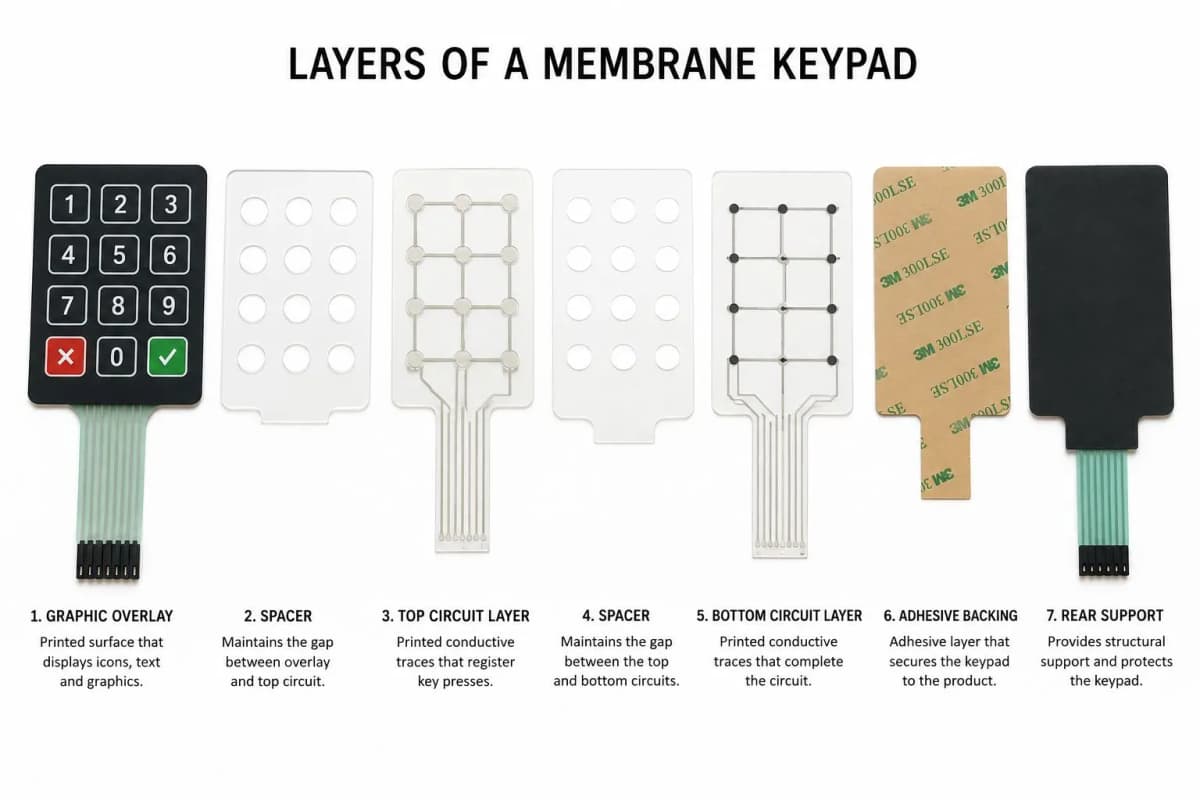
A membrane keypad uses adhesive in at least three places, and each has a different job. The spacer adhesive sets the air gap between circuits. The lamination adhesive bonds the overlay to the circuit. The rear adhesive mounts the finished keypad to the product. Treating them as one generic "adhesive" is a common source of failures.
Adhesive also interacts with materials. A bond that is perfect on a stainless panel may fail on powder coat, polypropylene or an oily surface. Temperature, humidity and cleaning chemicals change the picture again.
Key Takeaways
- Adhesive appears in three roles: overlay lamination, spacer between circuits and rear mounting. Each has its own requirements.
- Pressure-sensitive acrylic is the standard. Silicone and specialty grades cover high temperature and difficult surfaces.
- Low surface energy (LSE) grades are for plastics like polypropylene and for textured or powder-coated panels.
- Surface preparation is as important as adhesive choice. Clean, dry, correctly primed surfaces make the bond.
- Adhesive thickness affects feel, travel and stack height, so choose it with the whole design.
The Three Adhesive Roles
Overlay Lamination Adhesive
This bonds the printed overlay to the top circuit or to the layer below. It must be optically clear if the lamination covers a display window or a backlit area, and it must not cloud, yellow or bubble over time.
Spacer Adhesive
The spacer is usually a polyester film coated with adhesive on both sides, die-cut at each key. Its thickness sets the gap between the circuits and therefore the travel and the contact behaviour. The adhesive must resist creep, so the gap does not close up over the product's life.
Rear Mounting Adhesive
This fixes the finished keypad to the enclosure or panel. It is the layer most exposed to variations in surface type, cleanliness and temperature, and the one most likely to cause field issues.
Adhesive Family 1: Acrylic Pressure-Sensitive Adhesive
Acrylic PSAs are the standard for membrane switches. They bond with pressure, without heat or solvent, and resist UV, aging and many chemicals well.
Advantages: strong, stable and clear, good long-term aging, wide range of grades, cost-effective.
Limitations: standard grades struggle on low surface energy plastics and some textured coatings, and have limits at the highest temperatures.
Best for: most keypads and overlays on metal, glass, ABS, polycarbonate and similar surfaces.
Adhesive Family 2: Silicone Adhesive
Silicone PSAs stay flexible and keep their bond across a wide temperature range and on low-energy surfaces.
Advantages: high temperature capability, good on silicone and some low-energy materials, flexible at low temperature.
Limitations: higher cost, lower bond strength on some surfaces, and a risk of contamination in processes sensitive to silicone.
Best for: high-temperature equipment and applications involving silicone rubber parts.
Adhesive Family 3: Low Surface Energy (LSE) Grades
LSE acrylic adhesives are formulated for materials that normally repel adhesives, such as polypropylene, polyethylene, powder-coated metals and some textured plastics.
Advantages: reliable bond on difficult surfaces without special priming in many cases.
Limitations: cost is higher, and bond still depends on surface cleanliness and application pressure.
Best for: products mounted on polypropylene housings, powder-coated panels or textured enclosures.
Adhesive Family 4: Specialty and Permanent Grades
These include high-bond or aggressive grades for permanent mounting, removable or repositionable grades for service access, and chemical-resistant grades for harsh environments.
Advantages: tailored to a specific demand.
Limitations: may add cost, may restrict later rework, and should be validated for the environment.
Best for: medical, industrial and outdoor products with defined requirements.
Adhesive Types Compared
| Feature | Standard acrylic | Silicone | LSE acrylic | Specialty |
|---|---|---|---|---|
| Typical use | General mounting and lamination | High temperature | Difficult plastics and coatings | Specific demands |
| Temperature range | Moderate | Wide | Moderate | Varies |
| Bond on LSE plastics | Weak | Fair | Strong | Varies |
| Optical clarity | Very good | Good | Good | Varies |
| Chemical resistance | Good | Good | Good | Varies |
| Relative cost | Lowest | Higher | Moderate to higher | Higher |
Matching Adhesive to the Mounting Surface
- Metals and glass: standard acrylic usually works if the surface is clean.
- ABS and polycarbonate: standard acrylic is generally suitable.
- Polypropylene and polyethylene: use an LSE grade.
- Powder-coated surfaces: often need LSE, and the coating's texture and cure should be checked.
- Textured or rough surfaces: need thicker, more conforming adhesive, and sometimes a smoothing gasket.
- Oily or dusty surfaces: clean with an appropriate solvent, such as isopropyl alcohol, before application.
Application Matters as Much as Chemistry
- Clean the surface. Dirt, oil and release agents are the leading cause of weak bonds.
- Apply firm, even pressure. PSAs need pressure to wet out the surface. A roller helps.
- Control temperature at application. Very cold surfaces reduce initial tack.
- Allow dwell time. Bond strength grows over many hours, so avoid stress testing right after fitting.
- Mind curvature. Stiff overlays on curved surfaces create peel forces at the edges.
Manufacturing Insight: Send the supplier a piece of the actual mounting surface, with its real coating, and ask for a peel test. A bond that works on a lab steel panel can fail on a production powder coat, and the sample test costs very little compared with a recall.
Adhesive, Feel and Stack
Spacer adhesive thickness sets travel and contact timing. Thick or soft adhesive can damp the click of a dome, as covered in our dome types guide. Overlay adhesive thickness adds to stack height and can change how an emboss feels. When specifying, treat adhesive as part of the tactile design, not just a bonding layer.
Environmental Factors
- Temperature: adhesives soften when hot and stiffen when cold, so check both operating and storage ranges.
- Humidity and moisture: can reduce bond strength if the edges are exposed. See our guide on sealing and ingress protection.
- Chemicals: cleaning agents and fuels can attack some adhesives.
- UV: acrylics generally hold up well, but clear windows should be validated.
- Outgassing: sensitive applications such as cleanrooms or optics may need low-outgassing grades.
Common Mistakes
- One adhesive for every layer. Spacer, lamination and rear roles differ.
- Ignoring surface energy. Polypropylene and powder coat need LSE grades.
- Skipping surface cleaning. Contamination is the most common cause of failure.
- Testing too early. Bonds need time to build.
- Overlooking temperature extremes. Standard grades may fail in hot or cold equipment.
- Forgetting adhesive thickness in the stack. It changes travel and feel.
Decision Framework
- Identify the mounting surface material and coating.
- If it is a low surface energy plastic or powder coat, choose an LSE adhesive.
- If operating temperature is high, evaluate silicone or high-temperature acrylic.
- Confirm chemical and UV exposure, and pick a grade validated for them.
- Specify spacer adhesive thickness and creep resistance to hold the air gap.
- Plan surface preparation and application pressure, and test on real parts.
Frequently Asked Questions
What adhesive is used on membrane switches?
Most use pressure-sensitive acrylic adhesives in the spacer, overlay lamination and rear mounting layers, with silicone or LSE grades where conditions demand.
What is a low surface energy (LSE) adhesive?
LSE adhesives bond to materials such as polypropylene, polyethylene and many powder-coated or textured surfaces that standard adhesives struggle with.
How long does the adhesive take to reach full strength?
Initial tack is quick, but full bond strength often takes about 24 to 72 hours, so avoid stress testing immediately after application.
Can adhesive affect how a keypad feels?
Yes. Spacer thickness sets the air gap and travel, and soft or thick adhesives can damp the click.
Which adhesive suits high temperatures?
Silicone adhesives and high-performance acrylics handle higher temperatures than standard acrylics. Choose based on the actual operating and storage range.
Why does my overlay lift at the edges?
Common causes are a dirty or low-energy surface, insufficient pressure, chemicals or heat, or a stiff overlay on a curved surface. Surface preparation and the right grade usually fix it.
Conclusion
Adhesive is a design choice with three distinct jobs. Match each layer to its role, match the rear adhesive to the real mounting surface, and treat preparation and application as part of the specification. A small amount of testing on real parts prevents most adhesive failures.
To check adhesive choices for your design, contact our engineering team.